
A writer sets out to explore the slippery science of becoming someone new.
by Adrian Margaret Brune
April 14, 2026
When we first met thirty-one years ago in the student center at Northwestern University, Benoit Denizet-Lewis was a fraternity brother, sports columnist for The Daily Northwestern, and somewhat inhibited junior who rarely took off his baseball cap du jour. I wasn’t too far off my awkward teenage years and had just finished my youth tennis career after a second-year spot on the varsity team didn’t pan out. Still smarting from that and trying for an “in” as the tennis writer for the paper, I sat down with Benoit, who offered advice. I thought he came off a bit cocky; he probably thought I was a bit conceited and snobbish. He wouldn’t have been off by much. Both of us were in transition, shaking off the hangups and hangovers of our youths and preparing for the proverbial cold plunge of “real life.”
Just as I could take one look at my classmate, Peter Alexander, and know that he would go on to helm a microphone and a desk at NBC (his hair has been styled the same since age eighteen), I figured Benoit would become a renowned writer. But I surmised he would stay in his lane as a sports journalist, not veer way to the left with stories about living on the “down low,” the seven dimensions of sexual orientation, and transgender conservatives in the Trump era, among other subcultures, for New York Times Magazine. Nor would I be able to foresee that both of us would wind up young, gay, and on our way to overcoming different addictions—something about which both of us have written. I could lie and say I wasn’t envious of Benoit’s success as a book author, having previously come out with America Anonymous: Eight Addicts in Search of a Life and the New York Times bestseller Travels With Casey: My Journey Through our Dog-Crazy Country, but as both of us have grown up, I have discovered Benoit’s softer side, as well as his penchant for the off-kilter.
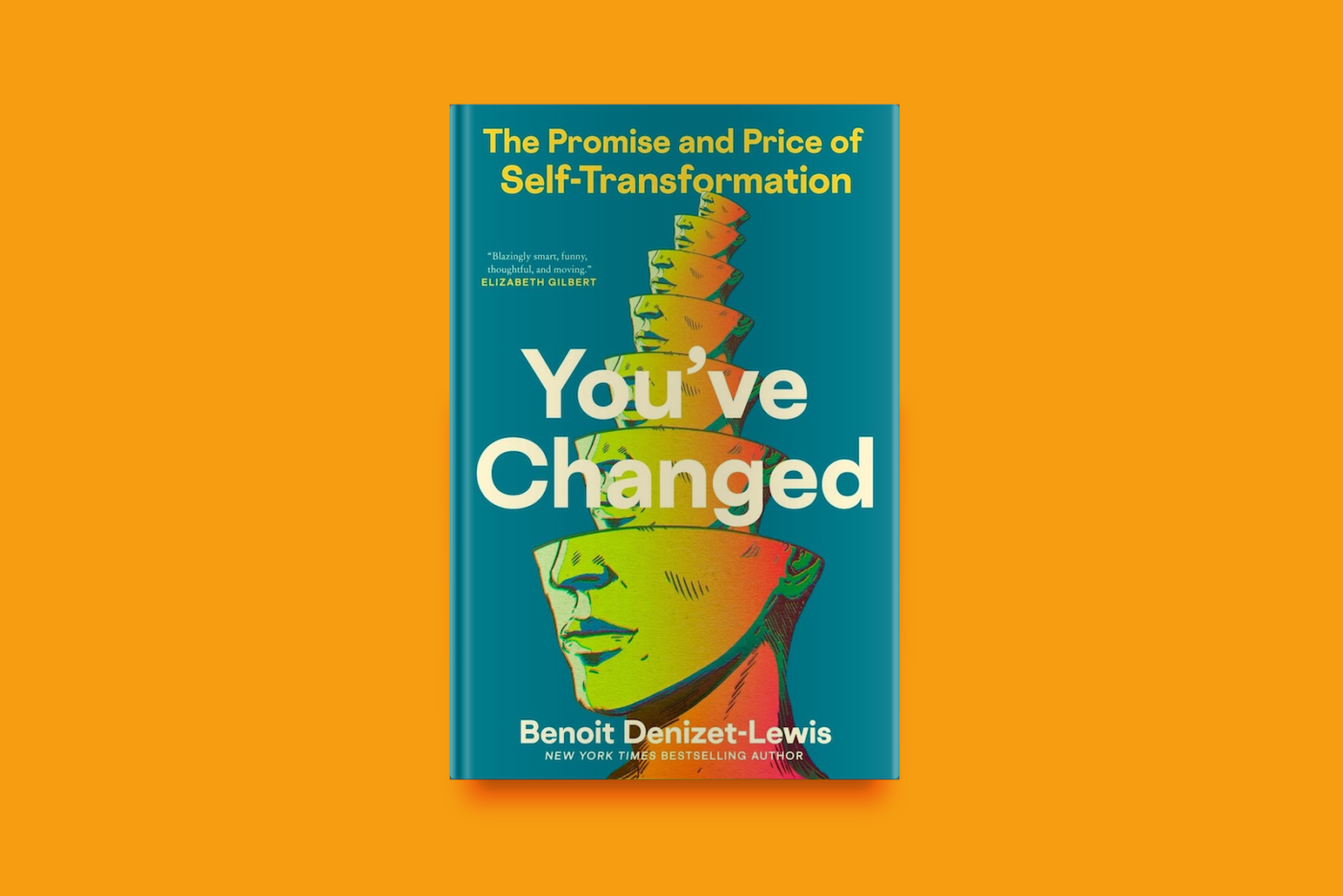
Benoit’s new book, You’ve Changed: The Promise and Price of Self-Transformation (William Morrow, 2026), is a testament to the paths Benoit will traverse to satisfy a curiosity and educate the populace about the unknown. Drawing on his background in deeply reported, psychologically rich nonfiction, Denizet-Lewis profiles an eclectic cast: a grandmother in her eighties attempting to rewire her nervous system, people navigating gender and ideological transitions, and individuals who committed serious crimes and may or may not be someone new. He also turns the lens on himself, weaving in his own stumbling attempts at change alongside the scientists, therapists, and specialists who study it professionally. The result is part portrait gallery, part memoir, part counterintuitive self-help, one that takes transformation seriously without pretending it’s tidy. Change, Denizet-Lewis argues, is possible, but it’s slippery, frightening, and politically complicated, and anyone who tells you otherwise is probably selling something. The book’s release this month gave us—these two old-skool magazine writers—a chance to catch up on life, projects, and how much both of us have changed. We spoke for nearly two hours. Here’s a bit of that discussion.
Adrian Brune
A lot has happened since we were burgeoning young journalists, Benoit. As the author of a book about how and why people change, what is your most significant change?
Benoit Denizet-LewisI
am married now! It wasn’t supposed to exactly work out this way. When I met my husband, it was certainly attraction at first sight, but it was kind of, Oh, I really enjoy this person; I laugh a lot with this person; this can’t work. He was a twenty-two-year-old from the Czech Republic working for the summer as a lifeguard near Boston, and I was, well, forty. There were a lot of things working against this: distance, age, our perspectives, our cultural language. I was talking to my therapist about him a lot early in our improbable relationship, and now I realize how much power she had. If she would have put her thumb on the scale and said something like, Well, Benoit, it sounds like perhaps this isn’t meant to be for you, it’s very possible I wouldn’t be married now. In the end, there’s a way we do decide that we’re going to love someone and we’re going to do everything to make this work, even though it doesn’t make a lot of sense at the time. And even though we are totally different—if we’re walking down the street, our eyes just see different things—and everyone assumed the relationship would end, we just barrelled through, and we developed a common language, and now I spend almost half of my year in Prague, which is good. I love Prague. And I adore my husband and can’t imagine my life without him.
AB
Did your husband inspire the book You’ve Changed, then? I have a theory that only two elements of life prompt people to change: love and death. Marek must have had something to do with it.
BDL
He’s been totally supportive of it, but he’s not the reason I started it. I don’t know about death because I’ve never lost anyone especially close to me—just my grandparents, really, some extended family members. On a personal level, I started working on the book in 2019, and it’s sort of hard to untangle my personal interest in changing myself or better understanding myself from this intellectual pursuit. I’d been trying to work through certain things for a while. Like, what do I make of my addiction? How do I be in a relationship and deal with my compulsive sexual behavior? I really struggled with the twelve steps, although I didn’t run away from treatment. And then I wanted to strengthen my relationships; I wanted to be a better boyfriend and husband, a better friend, a better son, treat myself—and other people—with more kindness and openness. I wanted to see if I could actually do it: change. Or if I was just going to try all these things and become who I was going to become, let nature take its course. One thing that is great about my husband is that he has never tried to change me, and I have never tried to change him. If we had tried to change each other, I don’t know if it would have worked. He never pushed me to become different than whatever I was.
AB
How exactly did he react when you headed off to Esalen, the famous not-for-profit holistic institute in California’s Big Sur National Park?
BDL
Well, there is this funny scene in the book in which he texts me during a “phone break” at Esalen and checks in to make sure I haven’t grown a long beard and decided to live in robes. But it was just an inside joke. Underneath that, we fall in love with some version of a person, and it’s scary to people to see the person we think we know and love change in a way that is confusing or unlike their old “selves,” so to speak. It was unnerving for me, too, wondering whether I was going to come out of this book with some realisation about my life, which is going to make me either blow it all up or be too afraid to blow it all up and just live with that realisation. With psychedelics, in particular, there is this fear that we won’t be able to control the change, won’t control the experience—that we will see things that we don’t want to see. Revelations force us to change or sit there with the revelations. But during it all, we have to gauge if we want to go through with something that will confuse the people who love us now—as is—and we lose that community. Or if working on ourselves is worth it.
There is this accepted truism in much of self-help culture that we shouldn’t change for other people, that doing so is misguided and means the change isn’t real or authentic. But the idea that we don’t change for other people goes against how most people actually change. We don’t want to lose something of value—our spouse, our children, our livelihoods—if we don’t go to treatment. But also, people see potential in us. I heard over the course of my work many times of people giving up on change, but a family member will encourage us, or someone will have a spiritual experience and be inspired to shift their lives.
“Change is relational, mysterious, confusing, exciting, scary, and often political.”
— Benoit Denizet-Lewis
AB
It seems as if “change” is generally in the air these days—from liberal to conservative, pro-immigrant to anti-immigrant, free speech to identity politics. Do people actually think they are evolving by switching political parties or becoming better by siding for or against certain policies? What’s with this?
BDL
The past decade, beginning in about 2015, has seen the most visible identity shifting since the 1970s, which was another period of political disillusionment, and social change, and unrest. But change in the 1970s typically meant that you impacted those closest to you. Now, not only do we need to convince friends and family, but we need to convince the parole board of the internet and broadcast those changes, narrate them. With social media, we can now tell the stories of our identity change for others to judge from the comfort of our own bedroom or the front seats of our cars. I’m interested in both how we narrate these profound identity-level changes and also how we interpret changes in other people: whose we validate and whose we pass off as too long down the rabbit hole, or grift, or insanity. One of the saddest things I’ve seen in talking to people is how much certainty people need to project and yet still feel so much doubt. Then, how doubt can be used against you.
In the latter half of the book, I try to navigate the choppy waters of gender and politics, and the experience of someone who goes through those shifts, and how others interpret them. The vast majority of them will ultimately insist they didn’t change, that everyone else did—“my party changed and went crazy, and so I had to get to stable ground.” We like to see ourselves as a steady intellectual force, whether we’re shifting from left to right or right to left—though those classic distinctions have been blurred over the last disorienting decade. But again, we are relational beings. I talked to many LGBT people who found themselves pushing back against an issue and have the experience of getting shouted down or ridiculed, feeling unheard or disrespected. That’s a real turning point. Like, “I’ve always been on the team, and now I’m getting shouted down?!” People feel deeply hurt and misunderstood, shamed, or disagreed with publicly. There’s a human reaction to that, and that reaction is to go where the water is warm.
AB
What did you appreciate most about writing this book?
BDL
One of the greatest joys and rewards of being a journalist is to spend time with people who have different world views than your own. I came to the subject with an open mind and open to new experiences, including encountering and trying to understand people with whom I disagree. How do we change each other’s minds? How do we change our own minds? I was able to observe and experience how connection and narrative influence people’s decisions to transform themselves or their identities. Being a nonfiction writer and a journalist has always affected the way I go through life. I picked journalism to be embedded in a culture, yet to come back and be removed from it. That appealed to me; I liked controlled connection. Two times in my life, I have actually had epiphanies or what one researcher called quantum-change moments. One of them took place in college—an internal voice saying, You’re gay—and then the realization that I had been so compartmentalized and so disconnected from my true feelings as a teenager that it was instantaneous acceptance, and my life changed. One minute I’m walking down the street thinking I’m one thing, and then—boom—an epiphany, and I’m something else. Fast forward a few years, I was reporting in San Bernardino, doing a story on evangelical youth ministries for my first magazine piece, and I spent a day watching them run to the stage and be saved, and I heard that same voice again, saying, Give yourself to God. I was completely confused. Why would I take on this identity that would complicate my life—would blow up my life? I didn’t end up becoming born-again that day, but I’m fascinated with these powerful experiences of conversion, of everything seeming to change in an instant. We don’t really realise how disorienting these sorts of revelations can be. It’s an interesting question: How do we integrate peak and mystical experiences in our everyday lives? Byron Katie, Eckhardt Tolle, AA founder Bill Wilson . . . they all underwent essentially rapid shifts that changed everything. Katie and Tolle claim to have woken up one morning feeling completely transformed; Wilson had a “white light” experience in a hospital room. But he couldn’t say, Wait for the white-light moment. He had to come up with a method for others to change, and that became the Big Book. People who get transformed in an instant are in a bit of a pickle when they want to help others change.
AB
You met quite a few people undergoing transformation. Who captivated you the most out of all your characters? Who may have disappointed you? Who surprised you?
BDL
Adrian, I met so many amazing people! A bully-turned-Buddhist. An octogenarian trying to change her personality so she could be closer to her loved one in the years she has left—she certainly inspired me. For my reporting I interviewed psychedelic voyagers, name-changers, prisoners who worked to transform themselves in prison, my dad—a meditation and breathwork teacher who I have in many ways become—and the originator of the iconic saying, “Be the change you want to see happen.” It wasn’t Gandhi! The people who disappointed me most were those who claimed to have easy answers about change—either how it happens or who gets to claim it. I was surprised by almost everybody, which is a fun way to go through life.
AB
How has this book changed you, if at all?
BDL
A huge part of my involvement in this was changing some of my ways, of course. I wanted to learn how to be a better friend. I could always be social, and I always had a lot of connections, but learning how to be honest and vulnerable and show up for people and be an actual friend. I wanted to be in a real relationship; I wanted to see people and be seen—I had never really allowed myself to be seen. Since I started this book, relationships have become the most important aspect of my life. I loved being a journalist, but looking back, I can’t believe I cared more about what some stranger across the ocean had to say about me or my writing, as opposed to the people closest to me. Writing this helped me to start to be a little bit braver in my life. I never felt like I could say what I really believed. I’m learning how to be a person who can reveal more of myself. Mostly, I realized there were two aspects to it: change requires honesty and vulnerability, and there are too many people pretending that there is some unique change formula—something that can be quantified, and bottled, and sold. It can’t. Change is relational, mysterious, confusing, exciting, scary, and often political. We need to approach it with some humility. There’s a line in the book that gets at this: “The only honest way to tackle change is to muddle through it with humility riding shotgun and holding the map upside down.”
Support BOMB’s mission to deliver the artist’s voice.
Since 2001, A.M. Brune has reported and written hundreds of freelance articles from pitch to print for publications such as The New Yorker, The Guardian, and The Spectator on a variety of topics, including world affairs, social justice, human rights, and culture. A former UN press officer, Brune holds a BS in Journalism from Northwestern University, an MS in Journalism from Columbia University in the City of New York, and an MA in Global Diplomacy from SOAS. She often brings along a camera on assignments.